
Merzouga is a village on the edge of Erg Chebbi, and almost everything to do there happens on or around the dunes. The sand rises to roughly 150 metres, which is what separates it from every other desert in Morocco, and what you do there is dictated by the light: activities happen at either end of the day and the middle belongs to shade.
Most visitors arrive by road from Marrakech, which takes two days of driving each way. That is the trade for the dunes actually being dunes.
Things to do in Merzouga
| Camel trek into the dunes | One to two hours at sunset, ending at the camp. The classic, and the reason most people come |
| Sunrise over Erg Chebbi | Free, and the best thing you will do. Walk up a dune behind the camp before six |
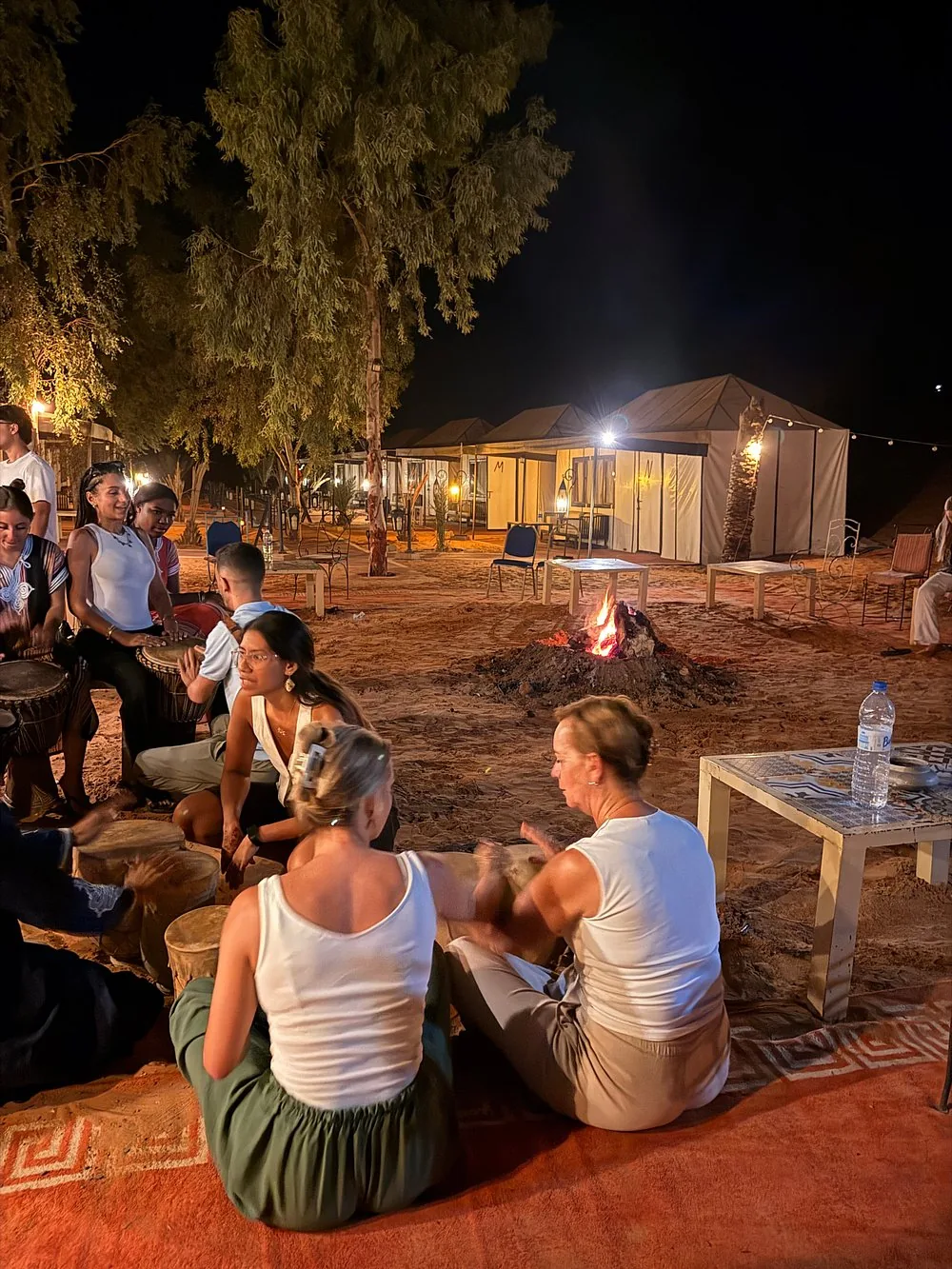
| A night at a desert camp | Dinner, drums around the fire, and a sky with no light pollution for 200 kilometres |
| Sandboarding | Slower than snow and harder work climbing back up, but children love it |
| Quad or 4×4 in the erg | Booked locally, usually an hour. Loud, and not for everyone |
| Khamlia and Gnaoua music | A village 7 km south, settled by descendants of Sudanese slaves. Live music most afternoons |
| Lake Dayet Srji | Seasonal, and full of flamingos after the spring rains. Dry by summer |
| The nomad families | Still living in the hamada around the erg. Visits are arranged through guides, not turned up at |
| Stargazing | The Milky Way is visible to the naked eye. Bring a blanket, the sand cools fast |
The dunes, and when to be on them
Erg Chebbi runs about 22 kilometres north to south and 5 across. From the top of the highest dune you see the ridge lines change colour every few minutes as the sun drops, which is why camel treks are timed for the last hour of light.
In summer, the afternoon is genuinely dangerous: it passes 45C and the sand holds the heat. Everything happens before nine and after five, and the middle of the day is spent under a roof. In winter the days are perfect and the nights drop close to freezing.
The camp, and what a night out there involves
You arrive by camel at dusk, eat a tagine under canvas, and there are usually drums. The tents on a private three day circuit have proper beds and a bathroom. On a shared circuit they are simpler, and the group is larger.
The part nobody prepares you for is the silence once the drums stop. There is no traffic, no generator after a certain hour, and the wind on sand is the only sound. It is the reason people who have done it once come back.
Beyond the erg
Khamlia, seven kilometres south, is worth the detour for the Gnaoua music alone. Rissani, forty minutes away, has one of the oldest markets in the south and a donkey park beside the car park, which tells you what the area still runs on.
The route in from Marrakech passes the Todgha gorge and the Dades valley, and on a four day circuit you stop properly at both instead of photographing them from the road.
How long you need
Three days is the minimum and it means two long driving days for one night in the dunes. Four days is the same route without the rush, with real stops at the gorges. Anything shorter than three is not Merzouga, it is Zagora, which is a different desert: we compared the two here.
Practical notes
Take cash: the nearest reliable machine is in Rissani or Erfoud. Bring a scarf for the sand and a warm layer for the night, in any month. Phone signal exists at the camps but data is slow. And leave the rolling suitcase in the vehicle, since it gets to the tent by camel.
The rest of what people ask before booking is in our Morocco travel tips, and the other six kinds of day are on things to do in Morocco.