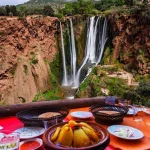




Most visitors spend three hours at Ouzoud Falls and leave without knowing what the name means, which mountains the water crossed to get there, or why the flow looks so different in March and in September. None of it is complicated, and all of it makes the visit better.
What the word Ouzoud actually means
The name is Amazigh, not Arabic. The reading you will hear most often on site is “the act of grinding grain”, a direct reference to the water mills the falls have driven for centuries. A second reading links the word to the Amazigh term for olive, which fits the terraced groves covering the slopes above the gorge.
Both readings describe the same economy. The river turned the millstones, and the groves supplied what was pressed. The name is not decorative, it is a job description.
The river carries a different name entirely. It is the El Abid, usually translated from Arabic as “river of the slaves”. Why it came to be called that is not documented, and local accounts vary.
Where Ouzoud is, and why people get the region wrong
Ouzoud is sold from Marrakech, so most visitors assume it belongs to the Marrakech region. It does not.
The falls sit beside the village of Tanaghmelt, in Azilal province, in the Beni Mellal-Khenifra region. They are 36 kilometres from the town of Azilal and about 150 kilometres north-east of Marrakech. That distance is the whole reason the drive takes two and a half to three hours each way, and why a rushed departure costs you time at the bottom of the gorge rather than time in the car.
Where the water comes from
This is the question almost nobody asks and everybody finds interesting once it is answered.
The falls are the single most dramatic drop along the course of the El Abid, a river that rises in the Central High Atlas. Its water is snowmelt and mountain rain, gathered far above the gorge, joined lower down by springs that merge into one stream before reaching the lip of the falls.
Below Ouzoud the El Abid keeps cutting through its gorge and feeds the reservoir behind the Bin el Ouidane dam, built in 1953 where the El Abid meets the Ahensal. Further downstream it becomes one of the main tributaries of the Oum Er-Rbia.
So the water you watch falling at Ouzoud came off High Atlas snow, and it is on its way to the Atlantic.
When the falls are at their strongest
This is worth knowing before you pick a date. Long-term flow records for the El Abid show that winter and spring together carry about 87 per cent of the river’s annual discharge.
In practice:
- March to May is when the falls are widest and loudest, and when the spray reaches furthest across the pools.
- February and June are still strong.
- Late summer is the thinnest flow of the year. The falls are still there, still 110 metres, but narrower.
Ouzoud never dries up. But a visitor in April and a visitor in September are not looking at the same waterfall, and it is fairer to say so than to show one photograph all year round.
110 metres, in three steps
Ouzoud drops 110 metres in three stages, the longest single fall measuring around 75 metres. That places it among the tallest waterfalls in North Africa.
The three tiers are why the site photographs the way it does. You see the full height first from the clifftop terraces. Walking down, you lose the top of it behind the rock. At the bottom you are close enough that the spray reaches you and the noise makes conversation difficult. Around the middle of the day the sun sits at the right angle to put a rainbow in that spray.
The macaques live there, they are not an attraction
The Barbary macaques in the gorge are wild and resident all year. Macaca sylvanus is the only macaque species living outside Asia, and the population along the path is used to people.
That habituation makes them easy to photograph and easy to underestimate. They are strong, they are quick, and food in a visible bag is an invitation.
Do not feed them, and keep your bag closed. This is not only about your fingers. The species is endangered, and a study of tourist-fed Barbary macaques in Morocco, published in PLOS ONE, found that the provisioned group showed disease symptoms nearly eight times more often than the group feeding naturally, together with raised stress hormone levels. Elsewhere in the central High Atlas, researchers comparing a tourist-visited group with a wild-feeding one found that human food accounted for 26 per cent of daily feeding records in the tourist group, against 1 per cent in the wild group, which rested more, behaved more aggressively, and foraged and moved less.
A photograph is worth more than a biscuit.
How much time the falls actually need
The stepped path from the top down to the pools and back up is the whole visit, and it is not a race. Three to four hours on site is comfortable: the descent, time at the bottom, lunch on one of the terraces, and the climb back.
Anyone arriving on a fixed group schedule spends that budget differently, because the return time is set before anyone has seen the water. That is the practical argument for going in your own vehicle, and it has nothing to do with price.
Seeing it for yourself
We run Ouzoud as a full day from Marrakech, in two formats. The private Ouzoud Waterfalls day trip from Marrakech gives you your own vehicle, your own guide and a departure time you choose. That matters more here than on most excursions, because the light at the bottom of the gorge changes through the day.
If you would rather share the vehicle and keep the cost down, there is also a shared Ouzoud Falls day trip running on a fixed schedule.
How far Ouzoud Falls is from Marrakech
About 150 kilometres, two and a half to three hours each way. That makes it a full day and not a half one: you leave early and you are back in the evening.
The road runs northeast through the plain, then climbs into the Middle Atlas foothills. It is an easier drive than the mountain roads south of Marrakech, with fewer bends and less climbing, which matters if anyone in your party travels badly.
| Distance | About 150 km each way |
| Driving | 2 h 30 to 3 hours each way |
| Total day | Full day, early start |
| Walking | A descent to the foot of the falls and back up. Steps and uneven paths |
| At the falls | Around 2 to 3 hours, including the walk down and lunch |
What the day looks like
You arrive late morning. The path down to the foot of the falls is the part to plan for: it is a genuine descent on steps and uneven ground, shaded by olive trees, and everything you walk down you walk back up. Take water and shoes with grip.
At the bottom, small boats take you close enough to the base to feel the spray. Restaurants are terraced into the cliff on the far side, most with a view straight onto the water, and lunch there is the usual midpoint of the day.
The macaques are real and they are wild. Barbary macaques live in the olive groves above the falls and you will see them. Do not feed them and do not get between an adult and its young.
Two ways to do the day: the private Ouzoud Falls day trip, where the timing is yours and you can stay longer at the bottom, or the shared Ouzoud day trip, which is the same falls at a fixed schedule and a lower price.
For how Ouzoud compares with everywhere else you might drive to from Marrakech, see how far the Sahara is from Marrakech, which lists every distance and drive time. For fitting it into your stay, see how many days you need in Marrakech.