


The Ourika Valley in Morocco is the mountain valley people go to when they have one day, not three. It is the closest one to Marrakech, which is the whole reason it works. But “close to Marrakech” gets quoted as anything between 30 and 70 kilometres depending on who is writing, and that gap changes what you can expect from the day.
Here is the Ourika, Morocco’s most accessible High Atlas valley, as it actually is: the distances, the waterfalls, the seasons, and how much time it needs.
How far Ourika Valley is from Marrakech
Both numbers you will see quoted are correct. They describe different places.
- The valley opens about 30 kilometres south of Marrakech, around Tnine Ourika, where the plain ends and the road starts to climb.
- Setti Fatma, the village at the head of the valley and the point almost every visitor is actually heading for, sits at 60 to 65 kilometres.
So a source saying “30 kilometres” is describing the entrance, and a source saying “65” is describing the end of the road. Plan on one hour to one hour thirty of driving each way to Setti Fatma. The first half is flat and fast, the second half is a climbing valley road where you will not average much speed, and where you will want to stop anyway.
That is the practical difference between Ourika and the rest of the mountains. Ouzoud is 150 kilometres out and needs two and a half to three hours each way. Ourika is the part of the Atlas Mountains near Marrakech that gives you the mountains and your evening back on the same day.
Planning the day? Our private Ourika Valley day trip picks you up at your riad or hotel in Marrakech and leaves at the time you choose. If you prefer to share the vehicle, there is also a shared Ourika Valley day trip.
What the valley is
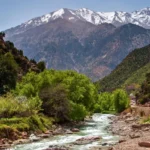
The Ourika follows the Ourika river south from the Marrakech plain into the foothills of the High Atlas, the highest part of the Atlas Mountains. It is farmed the whole way: terraces cut into both slopes, walnut and fruit trees along the water, and villages of red earth built into the hillside above the fields.
These are working Atlas Mountains Berber villages, inhabited year round by Shilha-speaking communities, and that matters to what you see. The terraces are worked because people live off them, not because a tour route needs a backdrop. The valley has stayed relatively well preserved despite sitting an hour from a city of a million people.
Above Setti Fatma the road keeps going and a branch climbs to Oukaimeden, at 2 600 metres, which is a ski station in winter and a high plateau the rest of the year. Almost nobody doing Ourika in a day goes up there, but it is worth knowing the option exists.
The Berber ecomuseum at Tafza
Partway up the valley, in the village of Tafza, a small ecomuseum occupies a restored red earth house. It holds Amazigh dress, silver jewellery and pottery from the valley. Entry is around 1 to 2 euros, and it sits close to the walking trails.
It takes twenty minutes and almost nobody stops. If you care about what the terraces and the houses mean, and not only how they photograph, it is the best twenty minutes of the day.
The Ourika waterfalls at Setti Fatma
This is what most people mean when they say Ourika.
Behind Setti Fatma a narrow gorge cuts back into the mountain, and a series of cascades drops through it, commonly counted as seven. They get higher and harder to reach as you go up. Most visitors walk to the first two, which is the honest and sensible version of the walk.
The path is not a groomed trail. It is rock, it crosses the stream more than once, and the stone stays wet all year from the spray. Count 45 minutes to an hour each way to the first cascades at a normal pace. Shoes with grip matter far more here than fitness does.
Turning back at the first fall costs you nothing. Nobody has seen the best of Ourika only if they reached number seven.
When the water is strongest
The Ourika is fed by High Atlas snowmelt, so the season changes the waterfalls more than it changes the weather.
- March to May is the valley at its best. Snowmelt feeds the falls, the terraces are green, and the water is at its loudest.
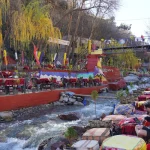
- June to August is hot in Marrakech and noticeably cooler by the river, which is exactly why Marrakchi families come up. Restaurants set their tables on platforms over the water. The falls are thinner.
- September to November is mild, quieter, and the light is good.
- December to February is cold in the valley and snowy higher up. The falls run and the paths are slippery. It is also when the valley marks the Amazigh new year.
What to take, whatever the month: cash for lunch and the small entry fees, shoes with grip, sunscreen and a hat, and a layer for the altitude if you go beyond Setti Fatma.
One thing worth saying plainly, because it explains why guides watch the sky here: the Ourika is a steep, narrow catchment, and a summer storm high in the mountains can raise the river fast in the gorge. A flash flood in August 1995 caused heavy loss of life in the valley. It is not a reason to avoid Ourika. It is a reason to be with someone who knows the valley and will change the plan if the weather turns.
Lunch, and what it costs
Eating by the river is half of why people come. Several restaurants at Setti Fatma set their tables beside the water, and in summer on platforms in it.
Expect roughly 6 to 12 euros a head for a tagine or grilled meat with bread and mint tea, paid on the spot. On our own private trip the meal is deliberately not included: you pick the place and you order what you want, rather than being delivered to whichever restaurant has an arrangement with the operator.
How much time the valley needs
A full day, and the honest breakdown is: an hour to an hour thirty on the road each way, an hour and a half to two hours for the walk to the falls and back, an hour over lunch, and whatever you spend stopping on the valley road. That fills a day comfortably without rushing.
What ruins Ourika is a fixed return time set before anyone has seen the water. The walk is the part that varies most between people, and it is the part a timetable squeezes first.
Seeing it for yourself
We run Ourika as a full day from Marrakech, in two formats.
The private Ourika Valley day trip from Marrakech gives you your own vehicle, your own guide and a departure time you choose. On this valley that matters more than on most, because the walk up the gorge does not run to a schedule and the light on the terraces is best early and late.
If you would rather share the vehicle and keep the cost down, there is also a shared Ourika Valley day trip running on a fixed schedule.