


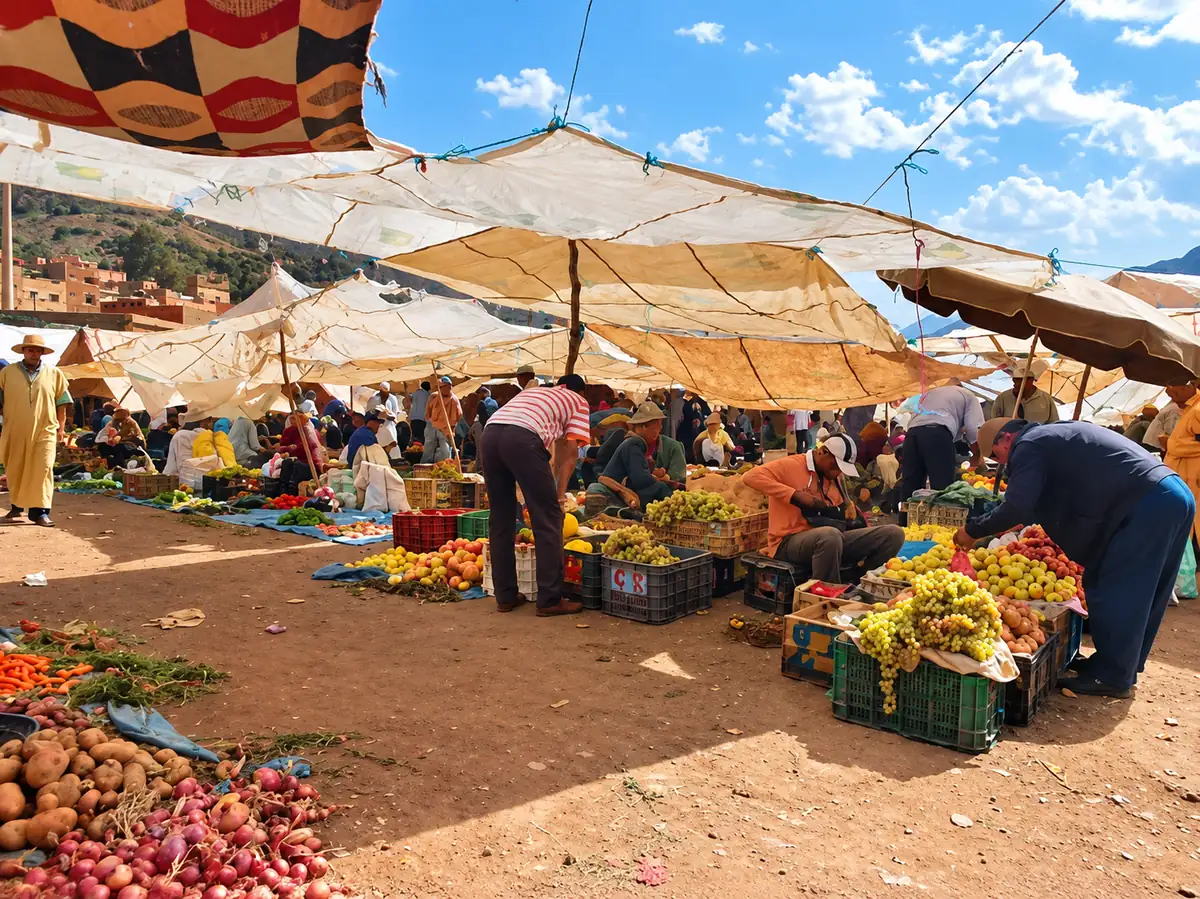
Around Marrakech, the rural Berber markets are held once a week, each on a fixed day, and the name of the souk tells you which day. Souk Tnine Ourika is on Monday, Souk Tlat Ait Ourir on Tuesday, Souk Larbaa Tighedouine on Wednesday and Souk Khmiss Tidili on Thursday. Farmers come down from the villages to sell their produce and livestock, and the whole area does its shopping for the week.
These markets have nothing to do with the souks of the Marrakech medina. There are no shop fronts and no souvenirs: just tents, produce on the ground and the people of the valley buying what they need.
Which Berber market is on which day
| Monday | Souk Tnine Ourika, at the entrance of the Ourika Valley |
| Tuesday | Souk Tlat Ait Ourir, east of Marrakech, one of the main markets of Al Haouz province. Amizmiz, south-west of the city, also holds its souk on Tuesday |
| Wednesday | Souk Larbaa Tighedouine, in the Zat Valley, about 63 km south-east of Marrakech |
| Thursday | Souk Khmiss Tidili, a rural market of Al Haouz in the Atlas foothills |
Markets also run on the other days in other villages, but these four are the ones we visit, and the ones we can vouch for.
How to read the name of a souk
Most rural markets are named after the day they are held, in Moroccan Arabic. Once you know the seven words, a road sign tells you when to come back.
| Had | Sunday |
| Tnine | Monday |
| Tlata, or Tlat | Tuesday |
| Larbaa | Wednesday |
| Khemis, or Khmiss | Thursday |
| Jemaa | Friday |
| Sebt | Saturday |
The habit goes so deep that many Moroccan towns carry their market day in their official name, such as Sebt Gzoula, Had Soualem or Jemaa Shaim.
What you find at a weekly souk
Mostly what a village needs for the week. Vegetables and fruit laid out on tarpaulins, bunches of fresh mint, sacks of spices, olives and pickles in buckets, dates and nuts. Further on, there is usually a livestock corner with sheep and goats, and at larger markets like Ait Ourir, camels too.
Then there is the food. Grill stalls send up smoke from mid morning, and you will find sfenj, the Moroccan doughnut, fried in front of you, and bowls of snails or chickpeas served as a snack. It is where the farmers eat after selling.
How a Berber souk differs from the souks of Marrakech
The medina souks are permanent, open every day and largely turned towards visitors. A Berber weekly market appears one morning a week, on open ground at the edge of a village, and is set up for the people who live there. Prices are local prices, few sellers speak English, and nobody is waiting for you. That is exactly its interest.
Tips for visiting a weekly market
- Go in the morning. That is when the market is busiest, before the farmers head home.
- Bring small dirham notes. Nobody has change for a large note, and nothing is paid by card.
- Ask before photographing people. A market is a place of work, not a set.
- Wear comfortable shoes. The ground is uneven, and muddy after rain.
- Stay close to your guide in the crowd, especially around the livestock.
How to visit with us
Our Berber market day trip from Marrakech takes you to the souk of the day, Monday to Thursday, with an English-speaking guide who explains the market and translates for you. The day then continues in the Berber village of Tighedouine, in the Zat Valley: the Ain Sidi El Wafi spring, the potters, a walk through the garlic and onion fields and lunch in a family home. It is private, with pick-up at 9:00 AM and back around 5:00 PM.