
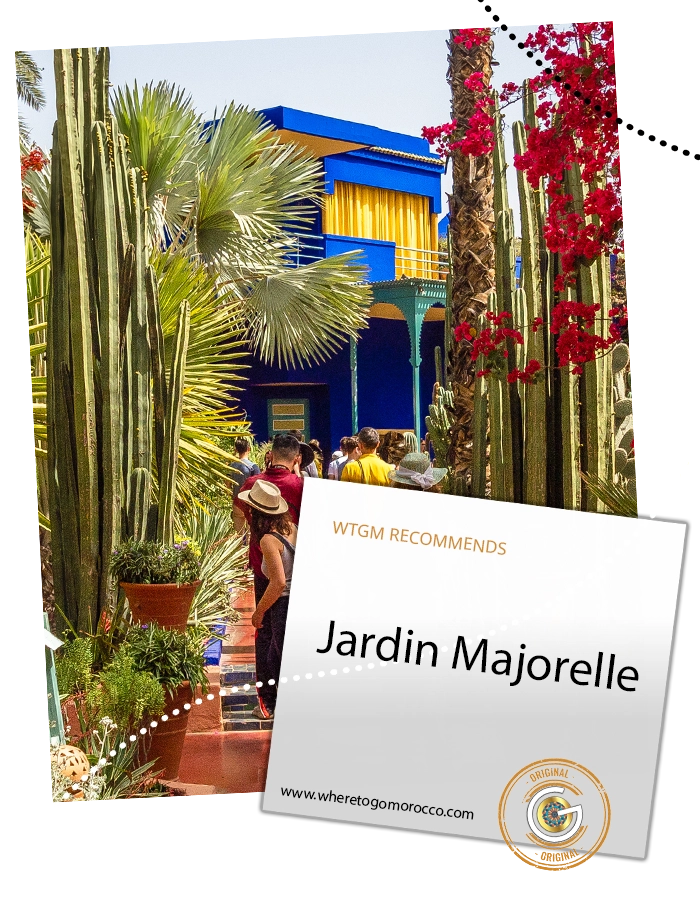
The garden is blue because of one decision, taken in 1937. Jacques Majorelle had built a cubist villa in his Marrakech garden six years earlier, and it was white. In 1937 he painted it in an intense ultramarine that leans towards violet. That colour is now known as Majorelle blue, and it is the reason most people come.
This guide covers where the colour actually came from, what is true and what is legend about the famous trademark story, and the practical side of a visit: tickets are sold online only, and one building on the site closes on Wednesdays.
Visiting: the essentials in one table
Prices are indicative for foreign adults and were checked in September 2026. Confirm them on the official ticket site before you pay, because the foundation updates them without notice.
| Jardin Majorelle | Berber Museum | YSL Museum | |
|---|---|---|---|
| Where | the garden itself | inside the garden | next door, separate entrance |
| Opening | 8.00 to 18.30 | 8.30 to 18.00 | 10.00 to 18.30 |
| Last entry | 18.00 | 17.30 | 18.00 |
| Closed | never | never | Wednesdays |
| Ticket | from 170 MAD | 230 MAD with the garden | around 140 MAD alone |
The combined ticket covering all three sites is around 330 MAD, and children under 10 enter the garden free. Allow forty five minutes to an hour for the garden alone, and about three hours if you are doing the whole complex.
The single most important practical point: tickets are sold exclusively online, at the foundation’s own ticket site. The on site ticket office has been closed since January 2023. Visitors who turn up without a valid QR code on their phone are turned away, and this catches people out every day. Morning slots in high season sell out one to three days ahead.
Where the blue actually came from
Jacques Majorelle was born in Nancy in 1886, the son of Louis Majorelle, one of the major Art Nouveau furniture designers of the Ecole de Nancy. He bought the plot on the edge of a palm grove in 1923 and worked on the garden for close to forty years, calling it his most beautiful work.
He did not invent the colour, and he never claimed to. He said he found it in what was already around him: the blue of zellige tilework, the surrounds of kasbah windows, the doors of adobe houses, the burnous and turbans of Amazigh men, the indigo veils of Saharan traders. Morocco had been living inside several blues for centuries, from three different materials. There was indigo, fermented from a plant and dipped into Atlas wool over and over. There was the cobalt of Fassi pottery, painted freehand on white tin glaze since Andalusian craftsmen brought the technique north after 1492. And there was the blue of cut zellige tile.
What Majorelle did was concentrate it. He took a colour that was spread thin across tiles, cloth and doorframes, and poured it over a single building until it read as one statement.
The blue is also not the whole story of the garden. What makes it work is the orchestration: cobalt set against the grey green of cacti, the deep green of bamboo, terracotta, and hard Moroccan light. He made colour decisions at the scale of architecture that he had spent a career making on canvas. Yves Saint Laurent, who bought the garden with Pierre Berge in 1980 and saved it from a hotel development, sharpened the effect further by painting pots in vivid yellow against the blue.
The trademark story, and what is actually true
You will read almost everywhere, including on Wikipedia, that Majorelle trademarked the colour before his death in 1962. That claim does not hold up, and it is worth knowing why.
You cannot register a colour as such, only a manufacturing process, which is what Yves Klein did for his own blue in 1960. No patent in Majorelle’s name has been found in the international databases. And the most telling detail is a silence: the foundation’s own website, describing its own signature colour, never uses the word trademark. It says only that the shade is known today as Majorelle blue.
What is genuinely registered are the names. The company and foundation that run the garden hold the marks Majorelle and Jardin Majorelle, and in 2018 the Paris Court of Appeal upheld their right to keep the garden’s name against a claimant. So the brand is real and defensible. The colour itself has no official definition. The hex code you will see quoted online is a later invention that Majorelle never specified and would not have recognised.
The ultramarine at the heart of it has its own history. For most of art history it was the most expensive pigment on earth, ground from lapis lazuli mined in essentially one valley in what is now Afghanistan, and worth more than gold by weight. Its name means beyond the sea. In 1828 a French chemist synthesised it industrially, which is the only reason a painter could afford, a century later, to drown an entire villa in it.
Practical notes people get wrong
Go at opening. The garden is compact, roughly four acres of the original plot plus later additions, and it fills quickly. The first slot of the day gives you the light and the quiet. Queues form even with a booked ticket, because capacity is capped at busy times.
Watch the Wednesday. The garden and the Berber Museum are open every day of the year. The Yves Saint Laurent museum next door, and the private Villa Oasis garden, close on Wednesdays. If your one free day in Marrakech is a Wednesday and the museum matters to you, move the visit.
Tripods are not allowed in the garden, which surprises photographers who have come specifically for the blue. Paths are gravel, so comfortable shoes beat sandals.
The garden sits in Gueliz, the newer part of the city, not in the medina. A petit taxi from anywhere in Marrakech is the simple answer. There is paid street parking on the road outside.
Fitting it into a Marrakech trip
The garden takes a morning at most, which makes it easy to pair with something else. If you are still working out how long to spend in the city and what fits around it, our guide to how many days to spend in Marrakech lays out the arithmetic, and the full range of trips and activities from Marrakech covers what is reachable as a day trip.
The classic pairings for the rest of the day are outside the city. The Ourika Valley is the closest mountain escape, around an hour out. The Ouzoud waterfalls are a longer day. And a sunrise balloon flight is the one thing that has to happen before the garden opens, not after.
Two practical questions come up constantly in Marrakech and we have answered both plainly: whether you actually need a guide, and how much to tip.
Frequently asked questions
Why is the Majorelle garden blue?
Because Jacques Majorelle painted his villa, which was white, in an intense ultramarine in 1937. He took the colour from Moroccan zellige tiles, kasbah window surrounds and Amazigh clothing rather than inventing it.
Can you buy tickets at the gate?
No. The on site ticket office closed in January 2023 and tickets are sold online only. Without a valid QR code you will not be let in.
How much does it cost to visit?
Around 170 MAD for the garden alone, 230 MAD with the Berber Museum inside it, and around 330 MAD for a combined ticket covering the garden, the Berber Museum and the Yves Saint Laurent museum. Under 10s go free. Check the official site for current pricing.
Is the garden open on Wednesdays?
Yes. The garden and the Berber Museum open every day. It is the YSL museum next door and the Villa Oasis private garden that close on Wednesdays.
How long do you need?
Forty five minutes to an hour for the garden itself. Around three hours if you are visiting the Berber Museum and the YSL museum as well.
Did Majorelle really trademark the colour?
Almost certainly not. A colour cannot be patented, no such patent has been found, and the foundation’s own site never uses the word. What is registered are the names Majorelle and Jardin Majorelle, upheld by the Paris Court of Appeal in 2018.