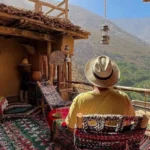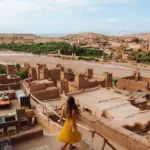

Morocco is safe for visitors, including women travelling alone, with the ordinary caution any busy destination asks for. Violent crime against tourists is rare. What you will actually meet is insistence: unofficial guides, unasked directions, pressure in a shop. A firm and friendly no ends almost all of it.
The risks that catch people out are duller than the ones they worry about. Sunstroke in summer, altitude on a mountain walk, and a stomach that needs three days to adjust send more visitors home early than anything else.
What actually happens, and what does not
| Violent crime | Rare against visitors. Morocco polices tourist areas heavily, including a dedicated tourist police force |
| Pickpocketing | Real in crowded medinas and around Jemaa el-Fnaa. A zipped bag worn in front solves it |
| Unofficial guides | The most common nuisance. They approach in the medina, offer help, then ask for money |
| Shop pressure | Persistent but not aggressive. Leaving is always an option and nobody follows you |
| Taxi overcharging | Common. Agree the fare before you get in, or insist on the meter |
| Scams | Wrong directions to a “closed” square, tanneries with a compulsory fee, a “festival” that does not exist |
| Road safety | The genuine statistical risk. Use a licensed driver rather than self-driving the mountain passes |
| Heat and sun | The most likely thing to spoil your trip. The south exceeds 45C in July and August |
Is Morocco safe for women travelling alone?
Yes, and thousands do it every year. It is also the question we are asked most, so it deserves a straight answer rather than a reassuring one.
What women report is attention rather than danger: comments in the street, questions about whether you are married, a shopkeeper who holds a conversation longer than you wanted. It is tiring rather than threatening, and it is worse in Marrakech and the big cities than in the mountains or the villages, where a woman alone is treated as a guest.
What works, according to the women who travel here regularly: sunglasses and headphones cut most street approaches before they start. A wedding ring, real or not, ends the marriage question. Covered shoulders and knees in a village or a medina make you unremarkable rather than modest. And saying no without smiling is not rude here, it is simply clear.
Practically: avoid walking unlit streets after dark, ask your riad to call a taxi rather than hailing one at night, and share your itinerary with someone. That is the same advice you would give for any city in the world.
The medina, and the guides who are not guides
Almost every uncomfortable story we hear starts the same way. Someone tells you the square is closed, the souk is shut today, there is a Berber market only on this morning. They then walk you somewhere, and at the end ask for money.
Nothing is ever closed. The square is not closed, the tanneries are not closed, there is no once-a-year market. Keep walking, say no thank you without stopping, and the approach ends.
A licensed guide carries a badge and will show it without being asked. If you want one inside the medina, book it through your riad or an operator rather than accepting one in the street. On a road day trip such as Ait Ben Haddou, the driver handles the route and a separate guide adds little.
Food, water and the three-day rule
Tap water is chlorinated and safe to drink in the cities, but it has a different mineral balance to what you are used to and most visitors switch to bottled for the first few days. Ice in a reputable cafe is made from treated water.
Street food is worth trusting where the queue is local and the turnover is fast. What to avoid is the opposite: a stall with food sitting out and nobody buying. Salads washed in tap water are the usual culprit rather than the grilled meat everyone worries about.
Bring something for an upset stomach and expect to need it around day three. It passes.
Heat, altitude and the roads
Between June and September, the south is genuinely hot: Merzouga and the Draa valley pass 45C in the afternoon. Desert activities move to sunrise and sunset for that reason. Carry more water than you think you need, and do not walk dunes at midday.
In the High Atlas, Imlil sits at 1 740 metres and the passes above go higher. Altitude sickness is unlikely on a day walk but the cold at the top surprises people who left Marrakech in a t-shirt.
Roads are the real statistical risk. The Tizi n Tichka pass is spectacular and demanding, with lorries, hairpins and no barrier in places. This is the strongest argument for a driver who does the route weekly rather than a hire car.
LGBT visitors
Same-sex relationships are illegal under Moroccan law. In practice, prosecutions of foreign visitors are very rare, and same-sex couples travel here regularly and without incident. The usual advice is discretion in public, which is what local couples of any kind practise anyway: public affection is uncommon in Morocco generally.
What to do if something goes wrong
| Tourist police | Dial 19 in cities, 177 outside. English is not guaranteed, French usually works |
| Ambulance | 15 |
| Lost passport | Report to the police, then your embassy in Rabat. Keep a photo of it on your phone |
| Your riad or operator | Usually faster than any official channel for a practical problem |
The short version
Morocco is a safe country with an insistent commercial culture, and visitors who expect the second are rarely troubled by anything else. Keep your bag zipped in a crowd, agree a taxi fare first, drink bottled water for a few days, and say no clearly when you mean it.
If you would rather not work any of it out alone, a guided trip removes most of the friction: someone else handles the route, the stops and the people who approach you. Our Morocco travel tips cover the rest of what people ask before booking.